

After being in the university for nearly four years, in the final year, to obtain the BA in TESL degree as an undergraduate, I had to complete my teaching practicum which gave the new experience and changes my life opening my career path. It was full of challenges yet great experience for life.
I completed my internship from 19th September to 25th October 2019 at We/Ke/Wedamulla Maha Vidyalaya. First, I was appointed to teach one grade 5 class and two grade 9 classes.
During my first three days, I tried to identify the learners’ proficiency level, their interest and to be familiar with the learners. Therefore, I did some language games with them. Third day onwards I started teaching them creating learner-centered classroom by giving them individual, pair, and group tasks.
Wroclaw (2011) stated that feedback could be delivered at any time and any stage of the learners’ learning process in forms of verbal, written, group, individual, self-correction, or peer feedback which help the learners to discover their strengths and weakness, motivates and help them to persist in their learning. Similarly, during in my intern, I have identified that for the grade 5 class giving comments like “excellent”, “very good” etc. and a star sticker creates a competition among the learners to do the appointed task correctly with a speed. Using this strategy was effective even for the slow learners to motivate them to do the task correctly.
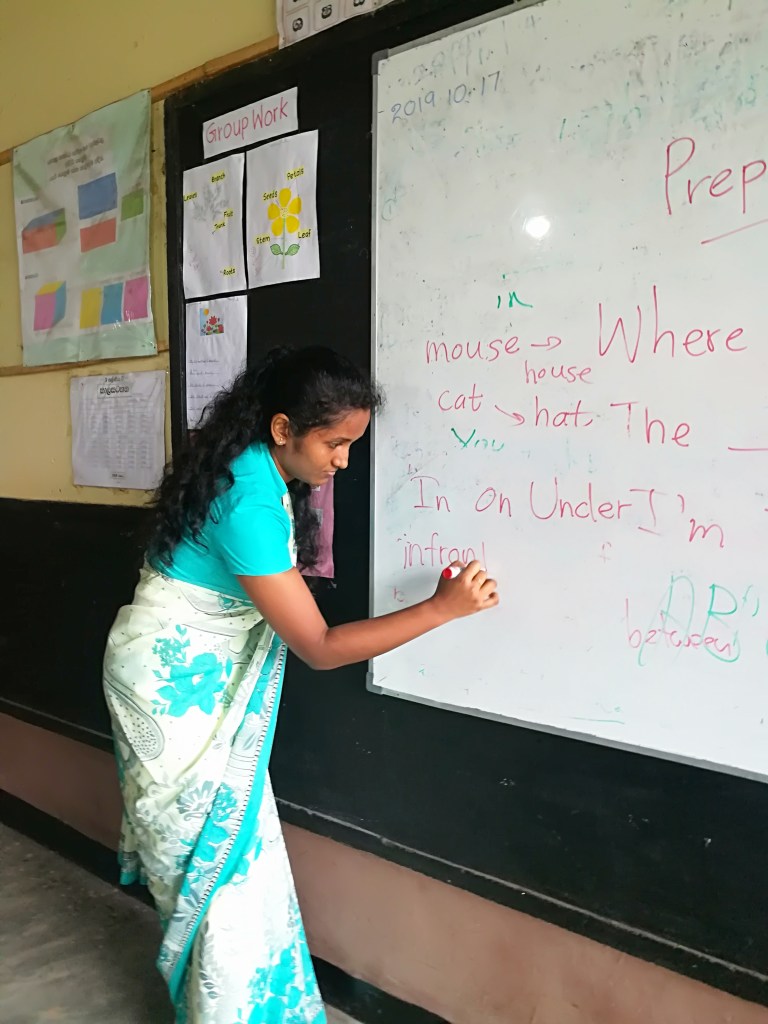
After the first week, there was a change in my classes and I was appointed to teach one class from each grade: grade 4, 5 and 9. Teaching for the learners of grade 4 was very challenging and I had to adapt to their level and be friendly with them. Yet, sometimes I had to be strict for them when I felt that I was going to lose the class control. I tried to be more creative when planning the lessons for them. Therefore, many entertaining tasks such as games, songs, group works, pair work and outside classroom activities were incorporated into most of the lessons. Students liked those activities and slow learners were also engaged in the tasks. According to the report of Primary Professional Development Service (n.d), working in group/ pairs help the learners to work collaboratively, encouraging slow/ shyer learners to speak/ contribute in front of the whole class.
When conducting grammar lessons for grade 9, I just asked questions in the first grammar lesson to brainstorm their memory and the students didn’t respond well. Therefore, the second grammar lesson onward I added mini exercises to brainstorm several grammar points and that strategy became effective. However, when teaching grammar lesson, I noticed that the learners were not much enthusiastic about learning grammar and always tend to tell that grammar is complex for us. Yusob (32018) claims that teaching grammar is always considered as the most difficult skill to teach and the most boring skill to learn. Therefore, if there is any mention of grammar in the classroom, it would cause students to have moments of anxiety. Hence, according to Yusob (2018), the language teachers have to do their best to make grammar lessons as “non-threatening, imaginative, creative and useful activity within the English curriculum” (p 149).
In each grade I used to speak in English yet, sometimes I had to use L1 (Sinhala) to explain some grammar parts, word meanings. In the primary classes in the first two weeks, I had to use more instruction checking questions and explanations in L1 as the learners are used to Sinhala instructions even in the English period. To avoid the L1 usage I made them practice some utterances such as ” Teacher, please come here”, “teacher, I can’t see the board”, “teacher can you move a bit”, ” what is the meaning of that?”, “teacher, can you explain it again”, etc. I didn’t response till they tried to speak in English and because of that, they kept trying to speak in English. From grade 9 students, I got several feed backs saying “Teacher speaks in English lot”. According to literature, the use of L1 in English classroom is debatable and Hanakova and Metruk (2017) stated that balanced approach which carefully uses L1 to facilitate and enhance the earning absorption of L2 might be the solution to the existing debate along with adjusting that balance to meet the needs and the levels of individual learners” (p 2).
When I teach, I tried to apply the theories that I have learned in the lectures. Vygotsky’s (1978) Socio-Cultural Theory was applied with grade 4 and 9 learners when doing group activities. It was much effective to be spread More Knowledgeable Others (MKOs) into separate groups breaking their usual grouping peers. Yet, the learners didn’t like it on the very first day. Moreover, Krashen’s (1982) Comprehensible Input Hypothesis was employed. In the textbooks of the primary grades include only five words for the vocabulary lessons. I taught them ten words with an additional five words for some lessons incorporating visual aids like pictures and videos as a prompt to remember those words easily. Min (2006) stated that the use of Vygotsky’s sociocultural theory and Krashen’s i+1 in second language acquisition is essential and language teachers should know how to apply them correctly with the learners putting the emphasis on the quality of classroom interactions.
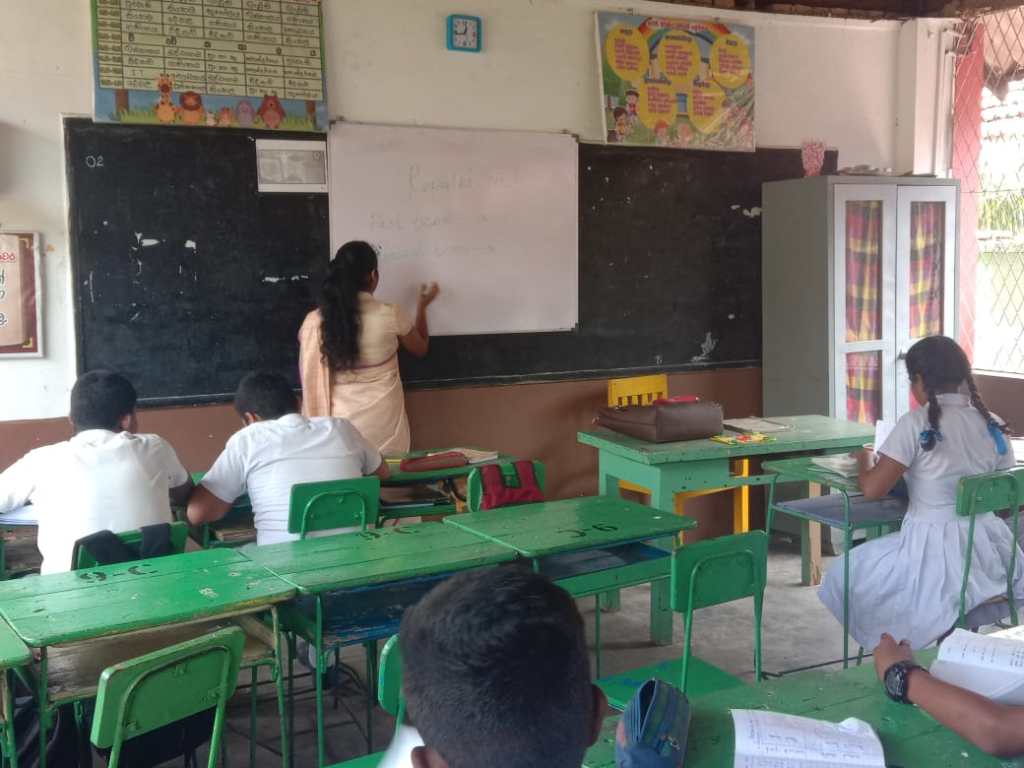
For the grade 9 and grade 4 students, I did a lot of additional activities on grammar and vocabulary lessons apart from the ones in the textbook and the workbook as I noticed that thy needed much practice, vocabulary and exposure to different types of tasks.
There were few unexpected situations that I encountered while teaching. Though I went to school on rainy days and the strike day, there were no students in my classes for four days. I was surprised and when I talked to the class teachers, they said that it was usual with them in such days. Moreover, there were a few days that there was a lesser number of students in the classes. So, I could not do the lesson with them. Yet, since was ready with some other activities I was able to do them. Through that, I learned the value of being ready with extra activities (lessons) to handle such unexpected situations. Nesari and Heidari (2014) fund that proper decision making and lesson planning as two options for teachers to manage the class properly.
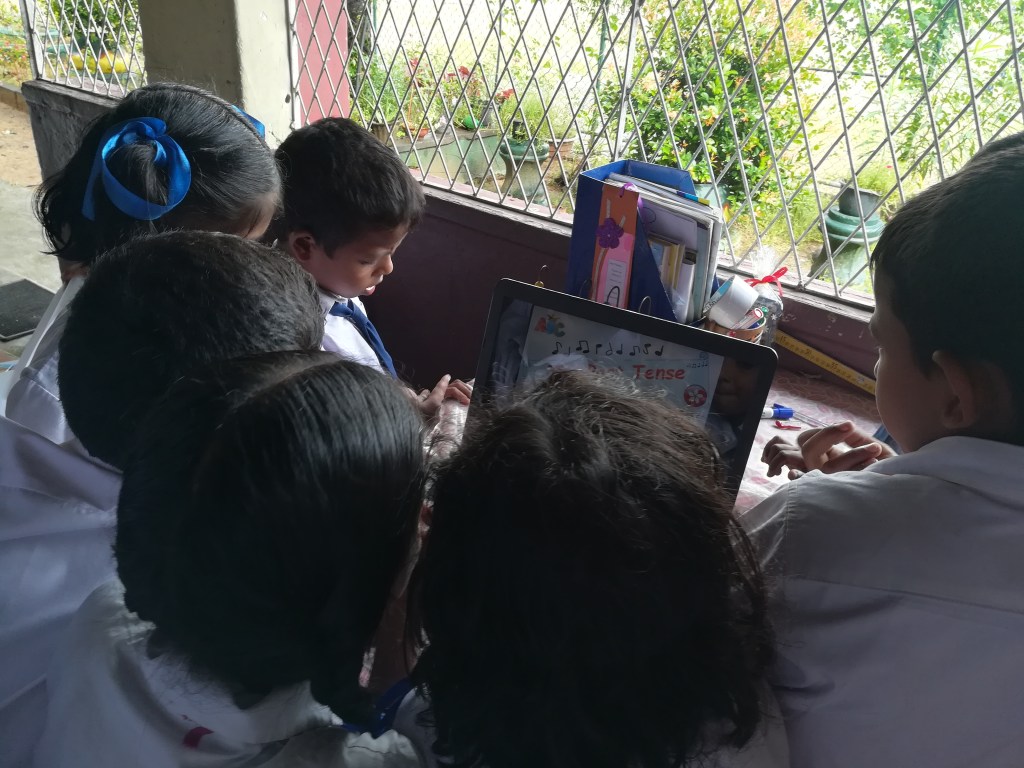
There were no facilities to use technology in the classroom. Though I had used my laptop and speakers to let the students do the listening activity by listing the song, it was not much success as they could not hear it well because of the noise from the other classes. However, that was the first time that the students did a listening activity in the classroom. Rosdy (2015) emphasized that teachers should pay much attention to different ways of ICT integration into the classroom rather than being limited to the traditional methods of teaching.
The primary earners had a practice of drawing pictures and colouring them for each lesson. This was the only simple activity that was given by their teacher in the English period. In the very beginning, it was challenging for me to change their way and make them into a track that was filled with different activities. Therefore, almost all the lessons that I did during my internship I tried to include matching, fill in the blanks, circling/ underlining activities to do individually in the class.
It was obvious that a schoolteacher had to play different roles; a teacher, advisor, mother, friend etc. during her teaching inside the classroom as well as the outside the classroom. I had to play each role in different situations at different levels during my internship. Moreover, the schoolteacher should have the courage to handle situations and be confident in teaching.
By the end of my internship, I have understood my strengths and weakness as a teacher. I had a lot of experiences in effective lesson planning, time/class management, feedback giving, class monitoring and language usage that were appropriated for the level of the learners apart from the unforgettable memories with the students. Finally, by the end of my internship, I realized that the role of a teacher is challenging and deep. Delivering lessons in a learner effective way and doing maximum the teacher can do, help the learners to do their job in a better way.
 Teaching Practicum Portfolio